Editorial
The hands behind the headlines
In meetings, we often see the project managers and directors.
They present the milestones, the timelines, the outcomes.
They carry the narrative forward.
But behind every milestone, there are hands. Invisible hands sketching the first layout at 7 a.m.
Hands adjusting a color scale so that a map can speak clearly across languages.
Hands rewriting paragraphs until complexity becomes clarity.
Hands translating not just words, but meaning, nuance, and diplomacy.
Hands taking notes in dusty field offices, listening before speaking.
Hands balancing budgets and columns of figures so that every project stands onsolid ground.
Zoï is known for its reports, its atlases, its workshops, its presence in international forums.
But Zoï stands because of those who build quietly.
The designers who turn data into visual pathways.
The cartographers who transform territories into understanding.
The editors who shape collective intelligence into a single voice.
The translators who ensure that no audience is left behind.
The social media manager who amplifies our voices and connects our work to the world.
The experts and partners on the ground who gather the first essential pieces of reality.
The board members whose guidance shapes strategic decisions.
And those who keep the numbers aligned, ensuring that ambition meets responsibility.
They are not always in the spotlight.
They are not always on the cover.
Yet they are everywhere in the work.They are the patience behind precision.
The structure behind creativity.
The discipline behind sustainability.
The rhythm behind delivery.
In 2025, as we explored new themes and continued navigating complex environmental challenges,
we wanted to acknowledge somethingfundamental:
Zoï is not a single voice. It is a constellation.
A constellation of disciplines.
Of talents.
Of quiet commitments.
This annual report carries the fingerprints of all those who work quietly behind the scenes.
Carolyne Daniel — One of the quiet hands shaping Zoï
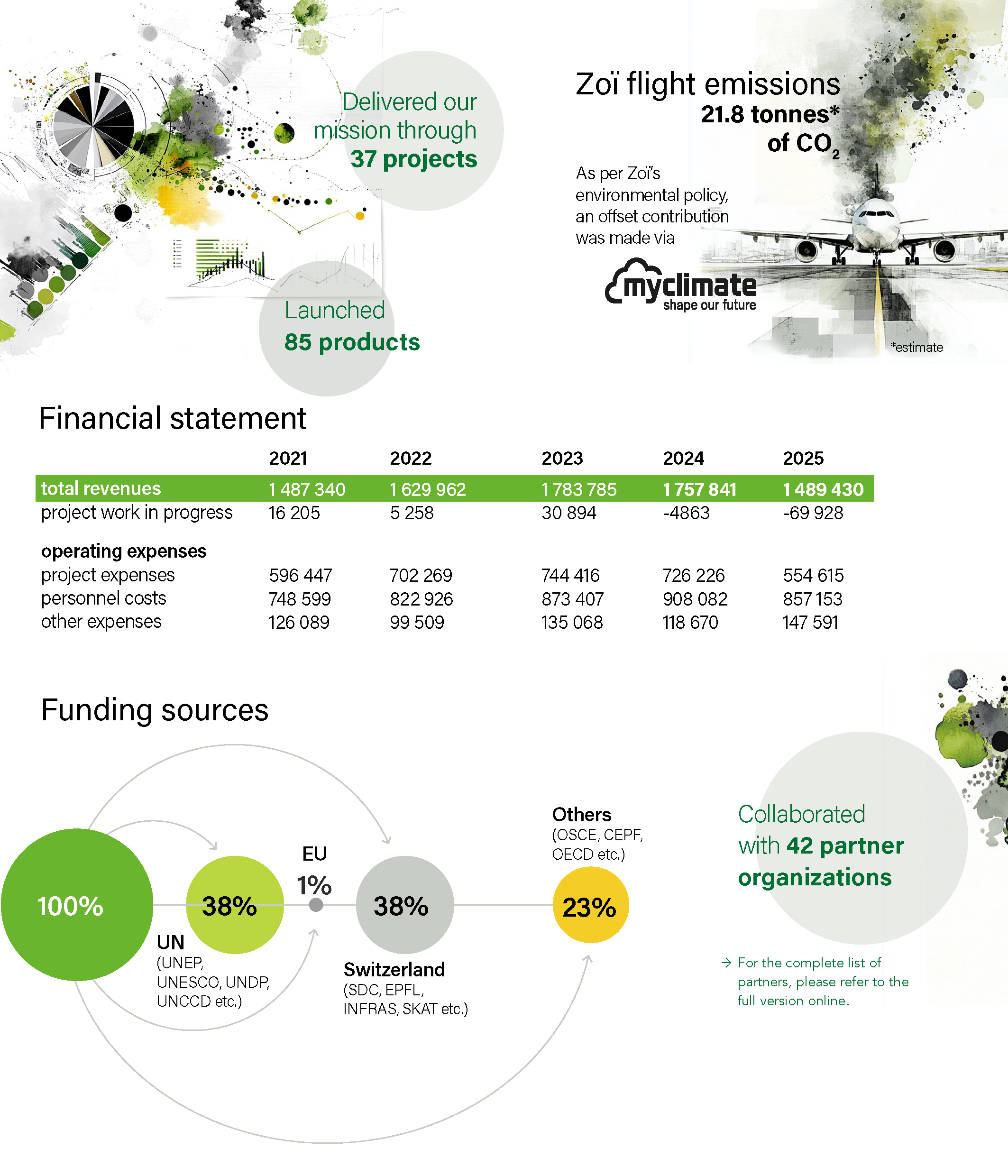
Financial statement
Maps in
the making
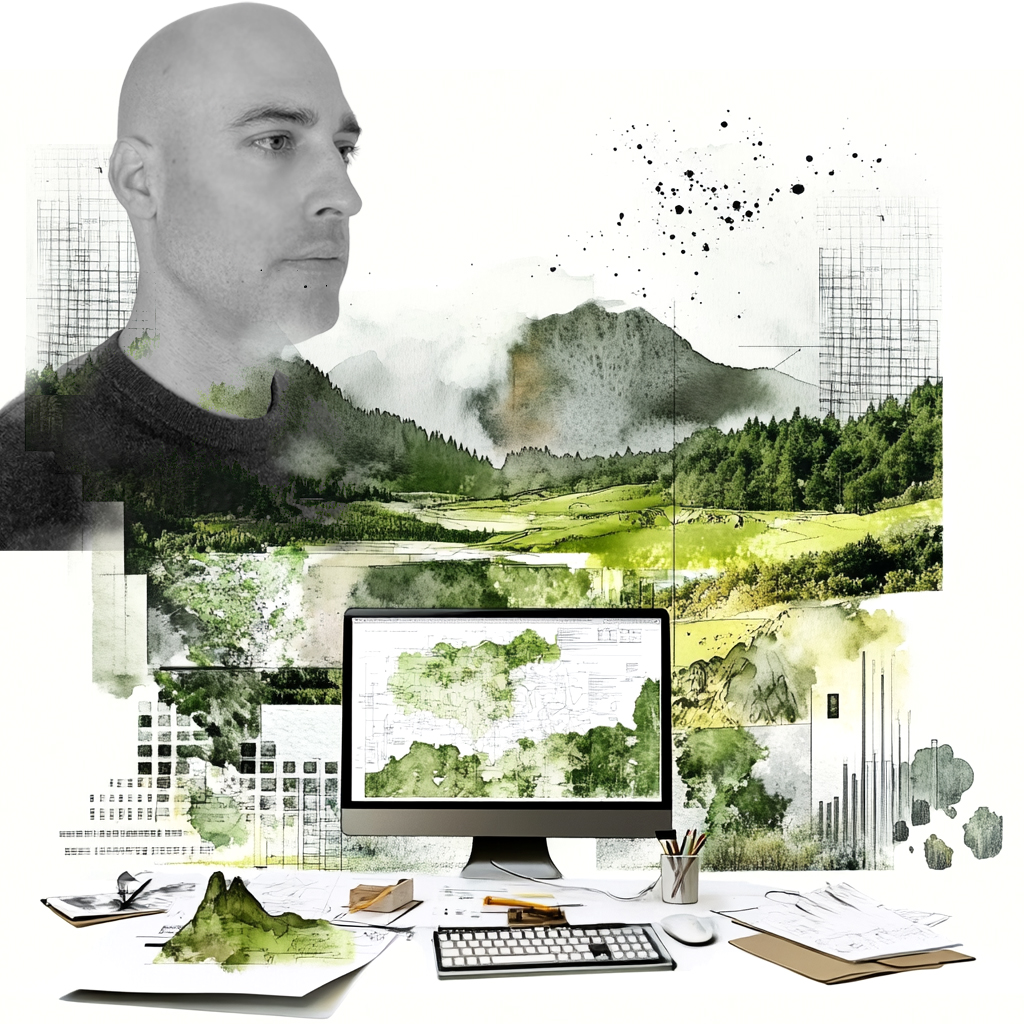
Matthias Beilstein
Highly relevant in the map making process is the interaction with the clients,
the Zoï project managers and at times with the researchers on the ground.
Ideally, this should be like a beautiful dance where one step leads to another. Suggestions, criticism, dead ends and break throughs are elements of this process. At times it happens that – like good wine – I have to let a map rest for a while and focus on something else. I may also just escape to the nearby forest, where it is not uncommon for new ideas pop up miraculously.
Technically, map creation is divided into information gathering, data processing and drawing. The order is not rigid, and quite often I do all at once, but this can vary greatly depending on the project. I have a whole set of IT tools, and AI is increasingly available. At times I also draw, paint or sketch in the good old manual way.
Working as a cartographer is a rather solitary trade, I often work alone in my office all day. To a certain extent, however, this isnot a disadvantage and is self-chosen. It helps me work in a concentrated manner, largely undisturbed by the outside world. In order to avoid loneliness, I programme my days to socialize during my free time. And then, for 1-2 months every year, I decamp to exotic locations (La Gomera, Okinawa) to stimulate my imagination and discover new ways of seeing and working in contrast to my quiet workplace at home in Schaffhausen.
I keep a rather positive attitude towards technical innovations, well aware of the downsides. And I maintain that in terms of further developments, the human factor remains decisive.
Thanks to artificial intelligence, certain tasks in map creation have become possible that were previously unthinkable – automatic relief shading, for instance. AI tools have become a companion in research throughout the day, hard to imagine life without them. The ubiquitous use of AI-generated contents may actually increase the value of highly reputable, certified information. In this regard, I routinely put every new map I create on a blockchain as a non-fungible token.
https://zoinet.org/product/mountains-in-motion-map-compendium/
https://beilstein.art/map-library
From global reports
to local conversations
I live in Jardín, a small mountain town in Antioquia, Colombia – a biodiverse territory, a landscape highly vulnerable to severe weather events. Here, climate change is not abstract. Last year, after weeks of heavy rain, a landslide blocked the San Juan River and destroyed the road connecting our town to the outside world. For nearly two months, we were isolated. Food and fuel became scarce. Hotels and restaurants stood empty. Daily life changed overnight.
In this same town, I am part of a women’s reading club with nearly 100 members. Every two weeks, many of us gather to read, write, and reflect. Over time, this circle has become more than a literary gathering – it is a community of solidarity and shared awareness of local and global challenges ranging from gender equity to environmental responsibility.
Some of the texts I translated for Zoï have reached this circle. While recovering from the landslide, we read excerpts from the Nexus Brief on Mountains in a Changing Climate. We also discussed the circular economy and later organized a community exchange inspired by those ideas. Next month, we will explore the Ecofeminist Climate Solutions Toolkit, a beautiful text I recently translated for Zoï.
These moments remind me that climate communication does not end with publication. It continues in conversations, in shared reflection, in local initiatives. Climate tools only work if they are understood.
Let us continueto build connections that turn knowledge into action.
https://zoinet.org/products/
Cristina Jaramillo Lopera
Making room
for intuition
The learning days were online, and with the schedule in front of me, I nervously logged in to the first Zoom call. The presenter started talking and my mind was immediately overwhelmed. To listen to the presentation and to read the Power Point slides while at the same time trying to pin down the essentials in the shape of an illustration was, to say the least, challenging. But somehow, after a quick chat with the presenter to coordinate, and after some clean-up, it made sense. The result turned out to be a visual summary of the session. I was so surprised! Someone asked afterwards if we used a machine to make these drawings. It felt like we had, that with no time to consciously review, choose, consider, or research, the advanced machine’s brain and hand had done this all by themselves. One part of my body was creating a baby, another creating drawings, both processes detached from my conscious mind and my otherwise analytical and judging eyes.
I went on to make visual recordings for the Minamata Convention – once for their COP-6, and again for their conference done in partnership with the OHCHR Indigenous Fellowship Programme. The biggest challenge for me was to find the overall message, and at the same time identify some details that could represent and convey this message. Thankfully, I had the communication team at the Minamata Convention and Alex Mackey at Zoï to support me. The work with the Minamata Convention has been as rewarding as the work on the learning days for the DRR platform, and it has been an enormous privilege to learn about the subjects presented at the sessions and conferences. I am also grateful for the revelation that came from setting a side analysis and judgement, and letting my intuition guide the work.
https://zoinet.org/product/minamata-cop6-illustrations/
Maria Libert
Digital communications
for a growing audience
As Zoï's content creator and social media manager, my challenge is to navigate the demands of algorithms while making sure our messages about the latest environmental issues reach more people. But social media offers more than that.
It allows me to bring back to Zoï the questions, perspectives, and inspirations of followers and friends across the globe, providing us the opportunity to make our communication more meaningful.
In addition to promoting Zoï’s work, I manage the social media for Adaptation at Altitude, an SDC program of which Zoï is part, focusing on increasing the resilience and adaptative capacity of mountain communities. One tool of this programme is the Adaptation at Altitude Solutions Portal, which collects activities that are being implemented in the mountains. Designing the digital campaign for the portal keeps me closely connected to the work of mountain communities across the globe, grounding digital communication in real experience and practical solutions.
On Zoï’s social media channels in 2025, we reached more users, added new interactions, and strengthened our digital community. We also launched a new website section – Activities, a collection that includes content about Zoï’s work with local partners, participation in conferences and events, and ongoing projects.
It has been a joy to collaborate with project managers on articles and other materials for the Activities section, and to share a behind-the-scenes look at the processes that shape our work.
In a time when digital communication is tending toward provocation and polarization, I feel privileged to be helping build networks of exchange, share messages of collaboration, and show that a better world is possible when communication is grounded in respect, attention, and curiosity.
https://zoinet.org/activities/
Camila Ponte
Celebrating glaciers and biodiversity
in my opinion, is to expose them to interesting new topics and prospects linked with international days, processes and events.
In 2025, we celebrated the International Year of Glacier Preservation. In collaboration with the Swiss Agency for Development and Cooperation and the University of Fribourg, we organized and conducted stakeholder events and contributed to international conferences on glaciers in Paris and Dushanbe. We also produced information products on the cryosphere. In Tajikistan, about half of the country is at elevations above 3,000 metres, and glaciers cover an area twice the size of forests. Glaciers, permafrost, and snow cover dominate, providing water for hydropower, irrigation, drinking, and ecosystems, especially during hot, dry summers. We are glad that the cryosphere is moving from the purely scientific domain into water management, infrastructure planning, and decision-making, but it certainly needs further popularization and broader mainstreaming. The Decade of Action for Cryospheric Sciences (2025–2034) is a timely and relevant opportunity for this.
Glaciers are cool. But my passion and original profession is conservation. In 2025, I was excited to work with the Critical Ecosystem Partnership Fund team on updating the ecosystem profile for the Mountains of Central Asia. The initial profile, which we produced in 2016–2017, introduced new concepts, such as key biodiversity areas, to Central Asia. As part of the profile update, we conducted stakeholder consultations in conjunction with celebrations of the International Day for Biodiversity, and received valuable inputs from partners across Central Asia. In parallel, we worked to elevate the role of civil society and local communities in conservation through our contributions to updates for national biodiversity strategies in the region. We appreciate the collaborative spirit of the government institutions at the forefront of conservation efforts, and look forward to the new phase of grants in 2026.
I am grateful to Viktor Novikov and all the Zoï team for their invaluable guidance and support. Their experience and knowledge are irreplaceable.
https://zoinet.org/product/ca-cryosphere-information-services/
Firuza Illarionova
Dmytro Averin -
Our man in Irpin
In the autumn of 2007, we took a group of Ukrainian, Belarussian and Moldovan journalists to Donetsk. We had previously worked with the regional administration there, looking at the environmental challenges that plagued the region which we called the “Coalland” in one of our publications from that time, and figuring out how solving some of them could strengthen Ukraine’s political stability. The journalists were to witness these challenges and explain them to people within and outside Donbas.
From the moment our group arrived and wherever we went, we were accompanied by an elegantly dressed yet humble young man who quickly and without ado resolved any issues along our way. That was Dmytro Averin, the head of the monitoring department at the regional environmental authority. So started our acquaintanceship that became our friendship and has lasted to this day.
Back then the Donetsk oblast had ambitions,and Dmytro wanted to turn its environmental monitoring into a cutting-edge automated system that would be the first of its kind in the country, and advanced even by EU standards. Zoï liked the idea and we started cooperating as part of the Environment and Security Initiative. By 2014, all the air quality observation posts in the region were connected, with their data series recorded and accessible for analysis and policymaking.
And then came the Donbas war. Dmytro with his family found themselves in Kyiv, with their hearts longing for home. We too were trying to figure out how we could help Donbas, which by that time was in our hearts as well, and agreed that the best we could do was to monitor and make known the environmental consequences of the war. In 2022, with the war embracing the whole of Ukraine, the Donbas Environmental Information System that Dmytro developed became Ecodozor.org. Backed by the OSCE and the UN Environment Programme, among others, this now well-known platform is documenting the war’s environmental damage in hope of using this knowledge for post-war restoration. Dmytro and his team in Ukraine have assured the continuous growth and daily operation of Ecodozor. The work ranges from collecting and analysing open-source data to mapping and presenting the results visually in cooperation with our partners such as the Conflict and Environment Observatory, thus contributing to awareness and policymaking within Ukraine and beyond.
Between 2014 and 2022, Dmytro worked closely with the Ministry of Environment Protection to help Ukraine advance its cooperation with the European Environment Agency. That track may soon and finally lead to the country’s full membership in this important European institution, one of the first on Ukraine’s road to the EU. As Ukraine’s future unequivocally lies in Europe, the country needs devoted professionals with visionary minds and European aspirations. Dmytro is clearly one of them.
https://ecodozor.org/index.php?lang=en
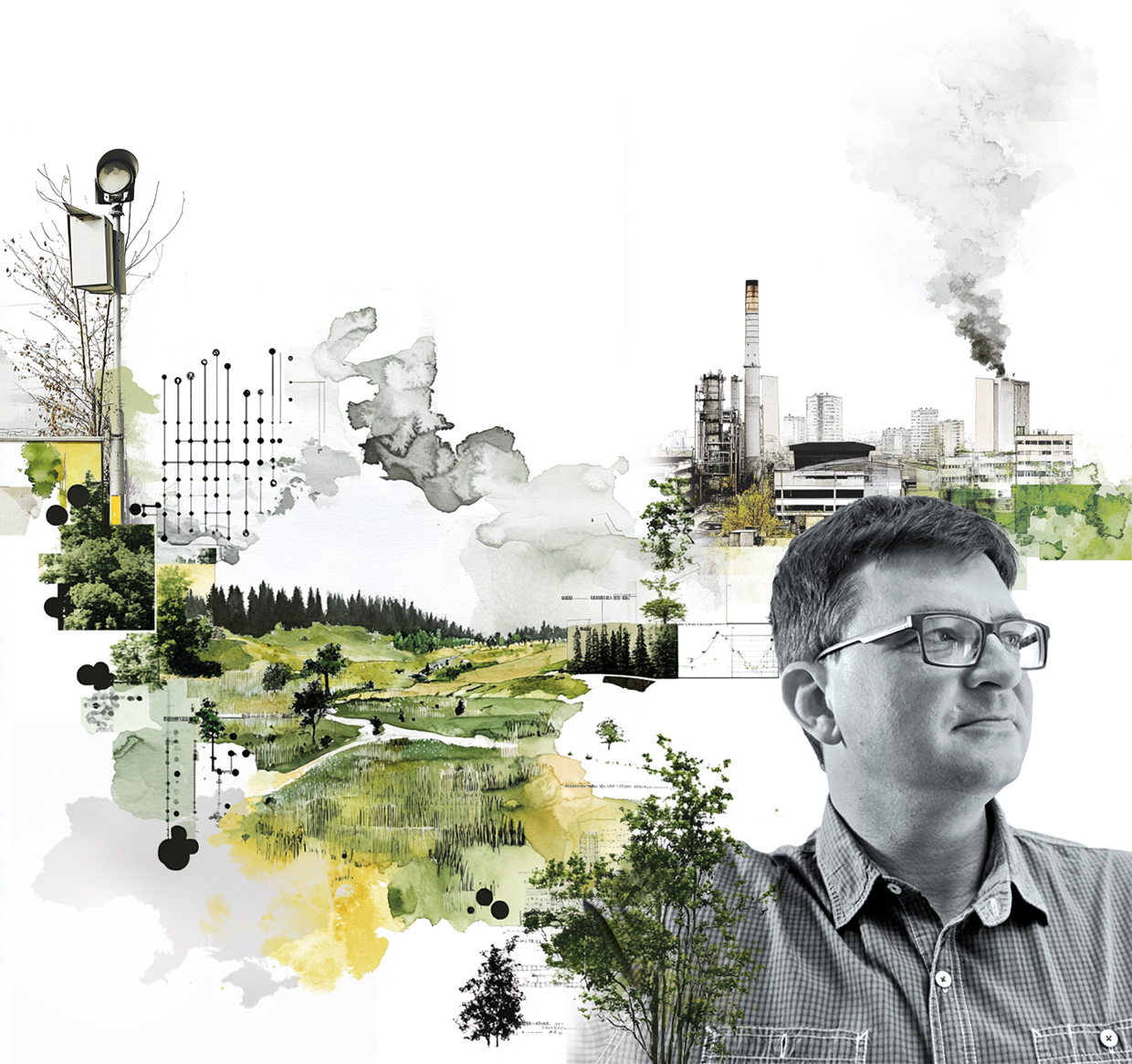
Dmytro Averin
People
Alex Mackey – Project management and analysis – Geneva
Alison La France – Key Performance Indicators (KPI) specialist – Geneva
Alexandra Povarich – Graphic design, climate and biodiversity – Taskhent
Camila Ponte – Content creation and social media management – Geneva
Carolyne Daniel – Print and digital design, artistic direction – Geneva
Defne Salli – Analyst and fact-checker – Geneva
Dina Adylova – Graphic design – Tashkent
Dmytro Averin – War impact analysis and data management – Irpin
Firuza Illarionova – Field and policy support Central Asia – Nicosia, Dushanbe
Geoff Hughes – Policy analysis, writing and editing – Port Townsend
Johanna Zwahlen – Project management and analysis – Geneva
Karma Denisov – Webmaster and social media – Himalayas
Lilia Wong – OSINT monitoring and analysis – Northampton
Maria Libert – Illustrations and graphic design – Stockholm
Maria Ziaja – Biodiversity and war (Intern) – Krakow
Marianne Gémin – Finance and administration – Geneva
Matthias Beilstein – Cartography – Schaffhausen
Nickolai Denisov, Deputy director – Environment and conflict – Geneva
Otto Simonett, Director – Creative thinking and leadership – Geneva
Viktor Novikov – Project development and management Central Asia – Geneva
Yevheniia Averina – OSINT monitoring and analysis – Irpin
Board members
Jörg Balsiger, President – Professor, Environmental Governance and Territorial Development, Université de Genève – Geneva
Karen Landmark – Director, GRID-Arendal – Arendal
Rupa Mukerji – SKAT Chief Executive Officer – St.Gallen
Associates
Aigerim Abdyzhaparova – BRI, climate, ecosystems – Prague
Aleh Cherp – Sustainability and energy – Lund
Alex Kirby – Environmental journalism – Lewes
Alexander Dyubinin – Biodiversity – Almaty
Alexandra Sternin – Graphic design – Konstanz
Alexandra Zaslavskaya – CSOs, environmental awareness and youth – Samarkand
Amangul Ovezberdyyeva – Climate change and biodiversity – Ashgabat
Andreas Trenker – Interactive design – Bolzano
Dasha Mokhnacheva – Climate migration, disaster risk reduction – Incheon
Denis Sorokin – Water and communication – Tashkent
Doug Weir – Conflict and environment – Hebden Bridge
Ecaterina Melnicenco – Climate and DRR – Chisinau
Elena Kreuzberg – Ecosystems – Ottawa
Eoghan Darbyshire – Conflict andremote sensing – Hebden Bridge
Evgenia Postnova – Environmental governance – Bishkek
Florian Wüstholz – Journalism – Bern
Gamal Soronkulov – Local development – Chatkal
Hasan Abdel Fattah – Chemicals and waste – Nablus
Hermine Cooreman – Web development – Ghent
Hongqiao Liu – Environmental safeguards China – Paris
Ilya Domashev – Biodiversity – Bishkek
Irina Bekmirzaeva – Climate change and biodiversity – Tashkent
Isacco Chiaf – Interactive design – Rome
Iskander Beglov – Water and communication – Tashkent
Jamilya Barotova – Environmental awareness, women and youth – Khamadoni
John Bennett – Environmental journalism – New York
Joel Rabjins – Animations – Ghent
Julia Rende – Graphic design – Stockholm
Kanybek Isabaev – Environmental information – Osh
Katy Ayres – Legal analysis – Strathblane
Liesbeth Eeckman – Animations – Ghent
Lina Valdshmit – Environmental governance – Almaty
Lusine Taslakyan – Environmental information – Yerevan
Mamuka Gvilava – Environmental impact assessment – Tbilisi
Marina Denisova – Copy-editing – Lancy
Maya Chami – Arabic layout – Beirut
Mazin Qumsiyeh – Biodiversity and sustainability – Bethlehem
Merdan Arazmedov – CSO, environmental awareness and youth – Ashgabat
Mikko Halonen – Environment and mining – Helsinki
Mohammad Hassouna – Environmental engineer – Marseille
Mohammad Najajrah – Entomology – Bethlehem
Myriam Steinemann – Climate change – Zürich
Natalya Beshko – Biodiversity – Tashkent
Oleg Lystopad – Media and communication – Kyiv
Pavlo Bystrov – IT and data management – Kyiv
Oli Brown – Security and environment – Samoëns
Oxana Huliayeva – Water ecology and hydropower – Kyiv
Peter Speelman – Legal analysis – Geneva
Rasul Ryskulov – Animations – Bishkek
Robert Bartram – Editing, writing – Geneva
Roman Kashkarov – Biodiversity – Tashkent
Samuel Gardaz – Red Sea corals – Geneva
Sergiy Zibtsev – Wildfire mapping and research – Kyiv
Stefan Schwager – Climate finance – Gümligen
Stephen Graham – Copy-editing and storytelling – Berlin
Susanna de Panfilis – Physics – Geneva
Svein Tveitdal – Climate change activist – Froland
Tamar Bakuradze – Environmental information – Tbilisi
Tamara Mitrofanenko – Intergenerational learning – Vienna
Vahagn Tonoyan – Water management – Yerevan
Valentina Grigoryan – Climate services – Yerevan
Vicken Cheterian – Research and journalism – Geneva
Yaroslav Tartykov – Graphic design – Bishkek
Zurab Jincharadze – Caucasus environment – Tbilisi
Zoï partners
Memberships
Consultative status with the UN Economic and Social Council (ECOSOC) and accredited with the UN Framework Convention on Climate Change (UNFCCC), UN Environment Assembly (UNEA), UN Convention to Combat Desertification (UNCCD), UN Convention on Biological Diversity (CBD) and International Organization for Migration (IOM).
Member of the Swiss NGO DRR Platform, NDC Partnership, BRI International Green Development Coalition (BRIGC) and Associated Programme of Flood Management (APFM) of the World Meteorological Organization and the Global Water Partnership. We are also a partner of the Mediterranean Action Plan (MAP)—Barcelona Convention of the UN Environment Programme.
Zoï 2025
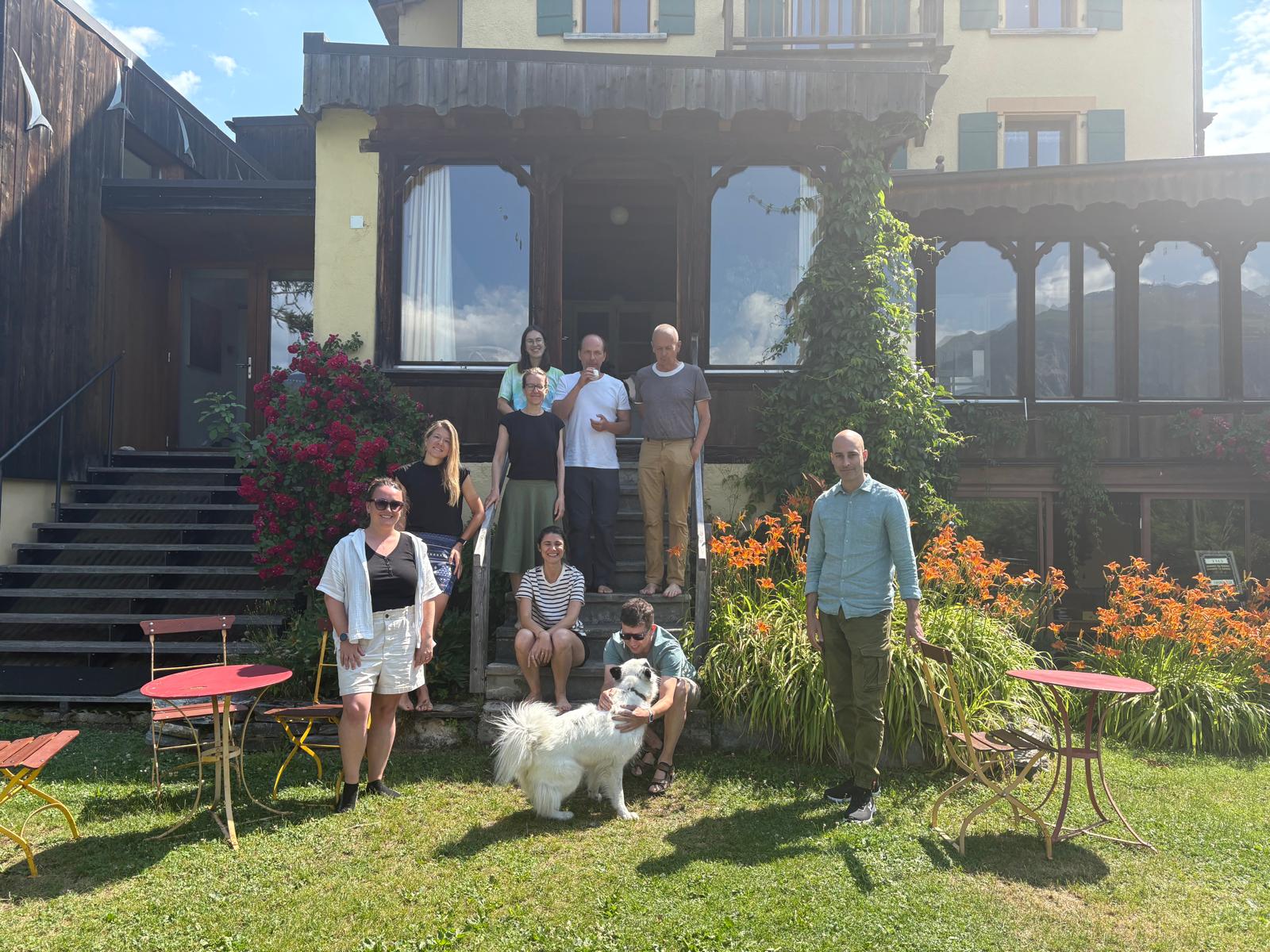
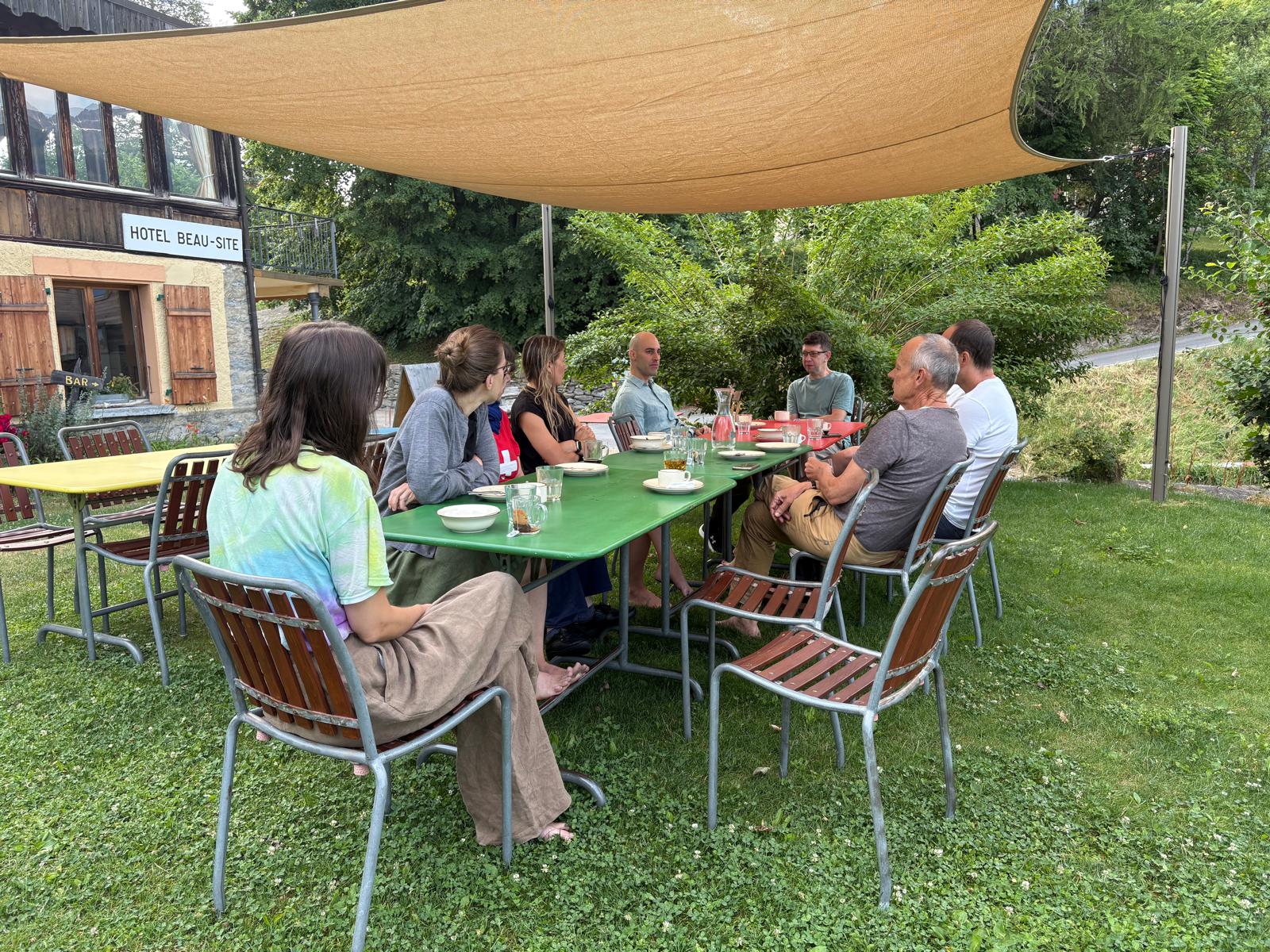
This year, our annual Zoï retreat took place at Beau-Site in Chemin, Valais, in July 2025.
We learned a lot from Alex, more than he would ever have imagined.
Most importantly, he showed us how to be generous and to say thank you. Now it is our turn to say, “Thank you, Alex. Thank you for being part of us, and for allowing us to be part of your life.”
Otto Simonett and Nickolai Denisov